With a population of about 156,000 people, Curaçao is smaller than many Kenyan constituencies and has almost one-eighth of Mombasa County’s population of about 1.2 million people.
Despite this, the tiny Caribbean nation has achieved what Kenya is still chasing: qualification for the Fifa World Cup.
The tiny nation has captured global attention ahead of the 2026 Fifa World Cup, especially after a viral image showed the team arriving in USA in a simple windowless bus instead of the luxury coaches commonly associated with football powerhouses. The image has sparked widespread admiration on social media, with many praising the country’s humility and remarkable football journey.

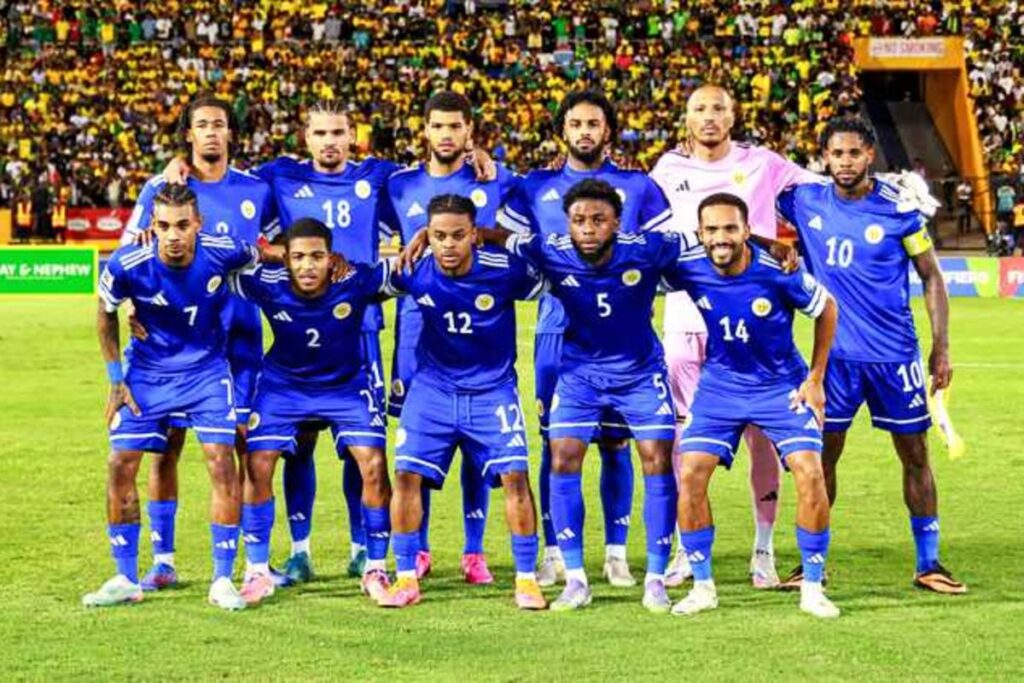
Soccer Football – FIFA World Cup – CONCACAF Qualifiers – Group B – Jamaica v Curacao – National Stadium Independence Park, Kingston, Jamaica – November 18, 2025 Curacao players pose for a team group photo before the match.
Photo credit: REUTERS/Gilbert Bellamy/File Photo
Curaçao is a small Caribbean Island located in the southern Caribbean Sea, off the northern coast of South America and 64.37 kilometres north of the coast of Venezuela. The country is a member of the Confederation of North, Central America and Caribbean Association Football (CONCACAF) and FIFA.
The island nation secured a historic first-ever FIFA World Cup qualification on November 18, 2025, after holding Jamaica to a goalless draw in the final round of the CONCACAF qualifiers. This made it the smallest country to ever make it to the World Cup tournament.
Curaçao finished top of Group B with 12 points, remaining unbeaten in a group that included Jamaica, Trinidad and Tobago, and Bermuda. At the 2026 Fifa World Cup, Curacao will play in Group E alongside Germany, Ecuador, and Cote d’Ivoire. The team will be hoping to defy the odds and progress to the knockout stages on their maiden appearance on football’s biggest stage.
Kenyans have reacted to Curacao’s achievement, with many drawing comparisons to Kenya’s continued struggles in football despite its bigger capabilities.
Football Kenya Federation’s (FKF) Youth Representative in Mombasa Jones Kyalo who is also coach of Mombasa-based Chaani Youth, said Kenya has failed to learn from other African nations that were once at the same level but are now dominating continental football.
He cited successful teams like Cape Verde, Cote d’Ivoire, Algeria and Senegal as some of the African countries that have become a powerhouses in African football after making deliberate investments in talent development, scouting and provision of sporting infrastructure.
“We were once almost at the same level with those countries but today they are far ahead of us. The difference is that they invested in systems while Kenyan leaders failed to build proper structures to develop talent,” said Kyalo.
While acknowledging that Curaçao plays in a less competitive football region compared to Kenya, Kyalo said the country has got basics of football development right as Kenya continues to regress. He said Kenya’s biggest challenge is not lack of talent but poor talent identification structure and weak grassroots football systems.
“You can have a player as talented as Lionel Messi in Turkana but if there is no functional talent scouting system, that talent will never be discovered. Talent identification is the foundation of football development,” he said.
He faulted the lack of youth development centres where identified talents can be trained, monitored and nurtured before graduating to the professional ranks. He argued that local coaches also need better training to equip them with modern football knowledge necessary for nurturing young players.
“If the foundation is weak, the national team will always struggle. Coaches at the grassroots level are the first people responsible for identifying and shaping talent,” he added.

Somali football referee Omar Abdulkadir Artan, who had been expected to officiate at the World Cup, has been denied entry into the US.
Photo credit: Denny Medley-Imagn Images via Reuters
Veteran coach and instructor Twahir Muhiddin blamed Kenya’s struggles in football on lack of long-term planning and constant changes in technical benches. He said countries that qualify consistently for the World Cup usually work on long-term projects spanning several years, allowing players and coaches to grow together under one philosophy.
“World Cup qualification requires a clear four-year plan. In Kenya, coaches keep changing and every coach comes with a different philosophy. That confuses players and affects continuity,” he said.
He challenged Football Kenya Federation to work closely with coach Benni McCarthy in developing a national football blueprint capable of transforming the local game over time.
According to him, McCarthy’s experience from the top leagues globally could help Kenya to come up with a strategy to qualify for the World Cup.
“He understands what it takes to prepare for the World Cup because he has experienced it before. The federation and government should support him and allow him to implement a long-term plan,” he noted.
Mr Muhiddin further blamed politics and lack of government support for slowing football development in Kenya despite FIFA providing financial and technical support programmes to developing football nations.
“Football cannot succeed without government support. In many countries, governments work closely with federations to support football projects. Here politics interferes with everything,” he added.
Equity Bank football club team member Muthoka Maingi Mulei said strengthening the local league remains one of the most important steps towards building a competitive national team. Mr Mulei observed that local players face many challenges ranging from financial difficulties, inadequate sponsorship and poor welfare, factors that affect their mental focus and overall performance.
“If the local league becomes competitive, it will be easier to identify quality players for the national team. Competition improves standards,” he said.
He noted that players in top football nations benefit from better facilities, quality nutrition and financial stability, allowing them to focus fully on football, unlike many Kenyan players who struggle with basic needs outside the pitch.
“Many players here leave training worried about many things including transport to training facilities and other social needs. In stronger leagues, players focus entirely on football because the environment supports them,” he added.
Beyond football, tourism stakeholders believe Kenya also loses a valuable global marketing opportunity every time it misses the World Cup.
With Curaçao now grabbing global attention, travel searches about the island’s tourism destinations, culture and attractions have significantly increased as football fans seek to learn more about the country ahead of the tournament.
Stakeholders say Kenya, with its globally recognised wildlife, beaches and athletics heritage, would equally benefit from massive international exposure if Harambee Stars qualified for the World Cup.
The global showpiece remains one of the most watched sporting events, attracting billions of viewers and generating enormous tourism and branding opportunities for participating countries.

Curacao fans celebrate after they qualify for the World Cup.
Photo credit: REUTERS/Gilbert Bellamy
Veteran hotelier and tourism executive Mohamed Hersi said Kenya cannot compare itself with nations that have deliberately invested in football structures over many years. According to him, qualifying for the World Cup is not an overnight achievement but a process built through long-term planning and development systems.
He however noted that although Kenya missed out on the global football showpiece, the country continues to enjoy strong international visibility through athletics and rugby, where Kenyan athletes and teams consistently dominate global competitions.
“Every month there is a marathon somewhere in the world and Kenyan athletes are making headlines. In rugby too, Kenya trends globally through the Sevens circuit. Football would have added another powerful platform to market the country internationally, but we still have a long way to go,” he said.
He observed that countries that qualify for the World Cup automatically attract global curiosity, with fans across the world searching for information about their culture, tourism attractions and history. According to him, Curaçao’s qualification has now placed the tiny Caribbean Island on the global map beyond football.
Hersi, however, maintained that Kenya can only achieve similar success if it invests heavily in sports infrastructure, youth academies, and talent development programmes.
“When Kenya performed well in football in the 1980s, the foundation had already been laid in the 1970s. Successful football nations invest in youth systems where players are nurtured from a young age. You cannot wake up and expect to qualify for the World Cup without structures,” he added.
Kenya and Curaçao present fascinating contrasts in almost all perspectives. In terms of population, while Curaçao has slightly above 156,000 people, making it smaller than many constituencies in Kenya, the East African country boasts a population of more than 55 million people.
In terms of land size, Curaçao occupies only about 444 square kilometres in the southern Caribbean Sea, while Kenya covers approximately 580,000 square kilometres, making the East African nation more than 1,000 times larger geographically.
Economically, the two countries also differ sharply. Reports show that Curaçao’s Gross Domestic Product (GDP) stands at about $3.5 billion (Sh451.5 billion), largely driven by tourism and service industries. Kenya’s economy is significantly larger, with a GDP exceeding $100 billion (Sh12.9 trillion), supported by agriculture, tourism, financial services and technology sectors.
In terms of FIFA ranking, Curaçao sits at number 82, while Kenya occupies position 111, remaining outside the top tier globally and having never qualified for the World Cup despite a pool of talent with players in competitive leagues across Europe.
Curaçao’s 26-man squad for the World Cup shows the country will benefit from a pool of foreign-based players spread across Europe, especially the Netherlands, with a few in England and Turkey.
Follow our WhatsApp channel for breaking news updates and more stories like this.