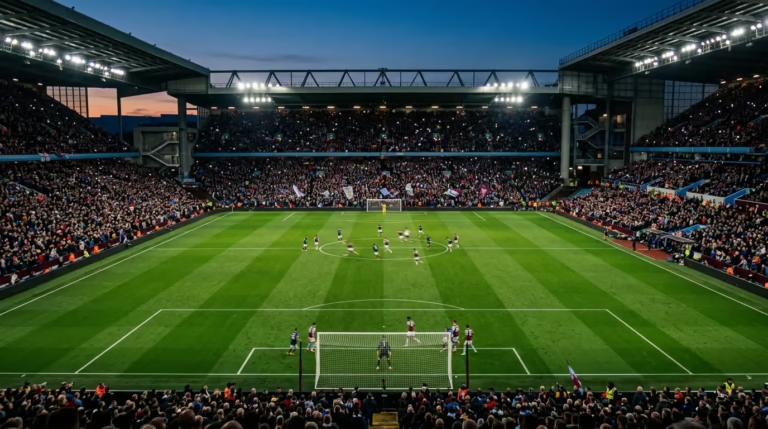
There is no Premier League football this weekend, and that absence is the biggest talking point in English football right now. The Premier League international break that began after Matchweek 5 is not a normal pause. It is the first of its kind: a single, extended window that swallows two weekends instead of one, running from 21 September all the way to 6 October.
Supporters who checked the fixture list expecting a Saturday 3pm kick-off found nothing. This Premier League international break has caught plenty of people out. Clubs have emptied their training grounds as internationals scatter across four continents. And the next time a Premier League ball is kicked in anger will be Saturday 10 October — a full 20 days after Manchester City beat Sunderland 5-3 to close Matchweek 5.
Why This Premier League International Break Is Different
FIFA calls it the “XL window”. Instead of the traditional pattern of a September break and a separate October break, the two have been merged into one longer block. National teams can play up to four matches in a single stretch rather than two or three across two separate call-ups.
The change was approved unanimously by the FIFA Council back in 2023, and three things drove it. First, the 2026 World Cup final falls on 19 July, the latest finish to a World Cup since 1966, which compressed the start of the domestic calendar. Second, player welfare: fewer separate call-ups means fewer long-haul round trips. A South American or African player based in England previously crossed the Atlantic or the Sahara twice in six weeks; now he does it once.
Third, and this is the part clubs quietly like, the total number of interruptions drops. This season there are four international breaks instead of the usual five. The Premier League calendar gets longer uninterrupted runs either side of each pause.
The Full Schedule: When Premier League Football Returns
Matchweek 5 finished on Sunday 20 September. Matchweek 6 begins on Saturday 10 October. In between, nothing domestic. That makes this Premier League international break roughly twice the length supporters are used to.
FIFA and the Premier League also agreed two scheduling protections around the window. There are no Monday night fixtures immediately before a break, so players are not travelling on a Tuesday after a late finish, and no Friday night fixtures immediately after one, giving returning internationals an extra 24 hours.
The remaining breaks this season follow the same extended pattern: 9–17 November, which takes out Matchweeks 10 and 11, and 22–30 March, which takes out Matchweeks 30 and 31. Plan your away days accordingly.
Here is how Matchweek 6 looks when football comes back on 10 October:
- Arsenal v Leeds United
- Aston Villa v Brentford
- Chelsea v Bournemouth
- Ipswich Town v Fulham
- Sunderland v Brighton
- Manchester United v Tottenham Hotspur (18:30)
- Crystal Palace v Nottingham Forest (Sunday 11 October)
- Hull City v Everton (Sunday 11 October)
Who Is Playing What During the Break
England have four fixtures during the Premier League international break, and the first is the headline act. Thomas Tuchel’s side host Spain at Wembley on 26 September — a rematch of the Euro 2024 final, and the sort of friendly-adjacent occasion that sells out in an hour. Czechia follow on 29 September, then Croatia away on 3 October, and Czechia again on 6 October.
Elsewhere, Germany face the Netherlands, France meet Italy, and Portugal take on Norway in a fixture that pits Cristiano Ronaldo against Erling Haaland’s international side. African players from Premier League squads are into AFCON qualifiers with two matches apiece. CONCACAF nations combine Nations League games with friendlies. Brazil play Australia twice before travelling to face India, while Argentina have Bolivia, Burkina Faso and Benin.
For clubs, that arithmetic is the uncomfortable part. A squad with fifteen internationals loses those players for the better part of three weeks, and the ones who travel furthest come back last.
Where the Table Stands Going Into the Break
Five matchweeks have produced 50 matches and 130 goals, an average of 2.6 per game, and those are the numbers that will sit frozen for the duration of the Premier League international break. Erling Haaland leads the scoring charts with five. Manchester City carry the longest winning run at five straight, and five clubs remain unbeaten: Brentford, Everton, Leeds, Liverpool and Manchester City.
At the other end, three sides are still looking for a first win after five games — Tottenham, Bournemouth and Fulham. Coventry have lost four in a row. Chelsea sit tenth, which is not where anyone at Stamford Bridge expected to be pausing for three weeks.
The final weekend before the break delivered two results that will sit awkwardly for a long time. Brighton beat Arsenal 3-0 on 19 September to climb to third, and Brentford put three unanswered goals past Chelsea the night before. Manchester City’s 5-3 win over Sunderland on 20 September was the highest-scoring game of the season so far. If you missed any of them, our Arsenal v Chelsea talking points and opening weekend review cover how these sides got here.
What Clubs Actually Do With the Time
Three weeks is long enough to be useful, which is unusual. A standard nine-day pause is mostly maintenance. An extended Premier League international break allows something closer to a mini pre-season.
Injured players get a genuine rehabilitation runway rather than a rushed return. Managers who arrived late in the summer — and there were several — finally get uninterrupted days on the training pitch with the eight or ten squad members who are not away. Some clubs will arrange behind-closed-doors friendlies against lower-league opposition to keep the non-internationals sharp.
Recruitment departments also use the window. With no midweek fixtures to prepare for, scouting staff travel, and January planning begins in earnest. Following the busiest deadline in years, the groundwork for the winter window starts now — our deadline day round-up sets out where squads were left.
Who Doesn’t Stop
The Premier League international break is not a universal pause. LaLiga, Serie A, the Bundesliga, Ligue 1, the Eredivisie, the J-League and the South African Premiership all go quiet alongside England. But Major League Soccer plays on, as do the Argentine Liga Profesional, Brazil’s Serie A and Liga MX.
Anyone needing a football fix during the Premier League international break has options, and live scores across those competitions are easy enough to follow on Flashscore while the Premier League sleeps. The Premier League’s own site carries the confirmed return dates and full fixture list.
What to Watch For When It Returns
A Premier League international break of this length changes things. The obvious risk is injury: every manager in the division spends this fortnight watching notifications and hoping none of them concern a hamstring. Historically, the weekend after a long break produces more muscular problems than any other.
Form is the other variable. Sides in a bad run get to reset, and sides in a good one lose rhythm. Brighton, third and flying, now sit still for twenty days. Tottenham, Bournemouth and Fulham get three weeks to fix what five games exposed. The Carabao Cup third round gave a few squad players a case to make; the break is when managers decide whether they listened.
And the fixture that returns loudest is Manchester United v Tottenham on the Saturday evening of 10 October. Two clubs with something to prove, a 18:30 kick-off, and three weeks of build-up behind it.
The Premier League international break is unusual, occasionally frustrating, and entirely deliberate. Football returns on 10 October. Until then, the story is the silence.